Halfway between a life lesson and a rumor, the legend of the giant serpent of the Verzasca Valley persists. People say it once lurked in the region, attacking shepherds and livestock before slipping backamong rocks and water. Attempts to track it failed, leaving scattered sightings and a lingering sense of threat. Through its unpredictable appearances, the serpent embodies a familiar fear: whatever disrupts the known and moves beyond established boundaries. As part of alpine folklore, the story warns of danger in a landscape that is anything but gentle, where tales of threatening creatures map the risks of moving through it. Yet the legend also points to something deeper. The villagers try to eliminate the serpent and fail, revealing an uncomfortable truth about human control over land and what exceeds it. In the end, the story acknowledges a shared vulnerability. The serpent as a metaphor remains open, standing for what persists beneath the surface, unsettling the established order, and resisting definitions.
A glimpse of something long and sinuous, appearing and disappearing, gradually thickens into a presence no real creature could account for. We left skin in the cracks begins from that accumulation. In Massimiliano Rossetto’s exhibition, the serpent never appears, yet its presence feels diffused through the room.
A glimpse of something long and sinuous, appearing and disappearing, gradually thickens into a presence no real creature could account for. We left skin in the cracks begins from that accumulation. In Massimiliano Rossetto’s exhibition, the serpent never appears, yet its presence feels diffused through the room.
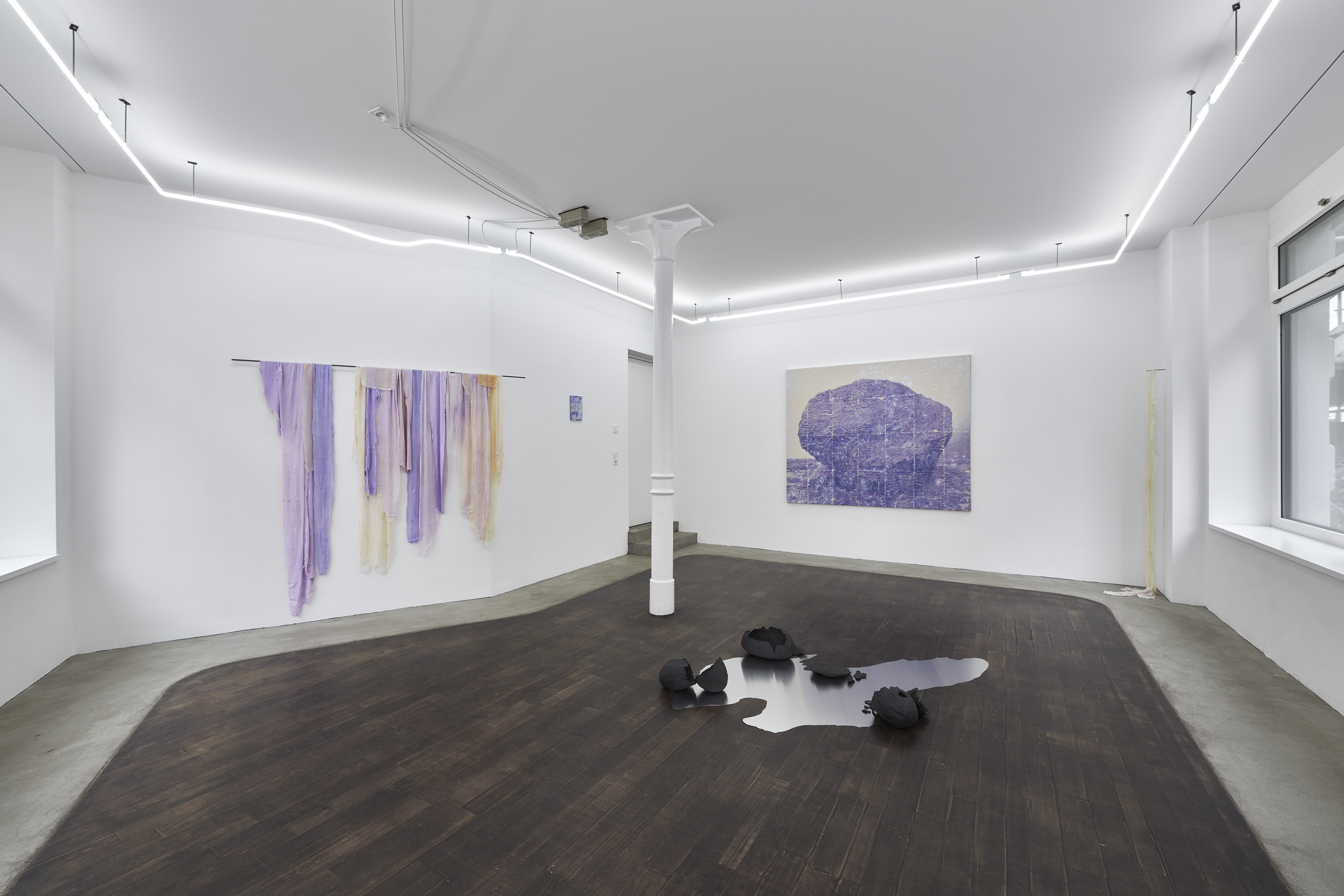
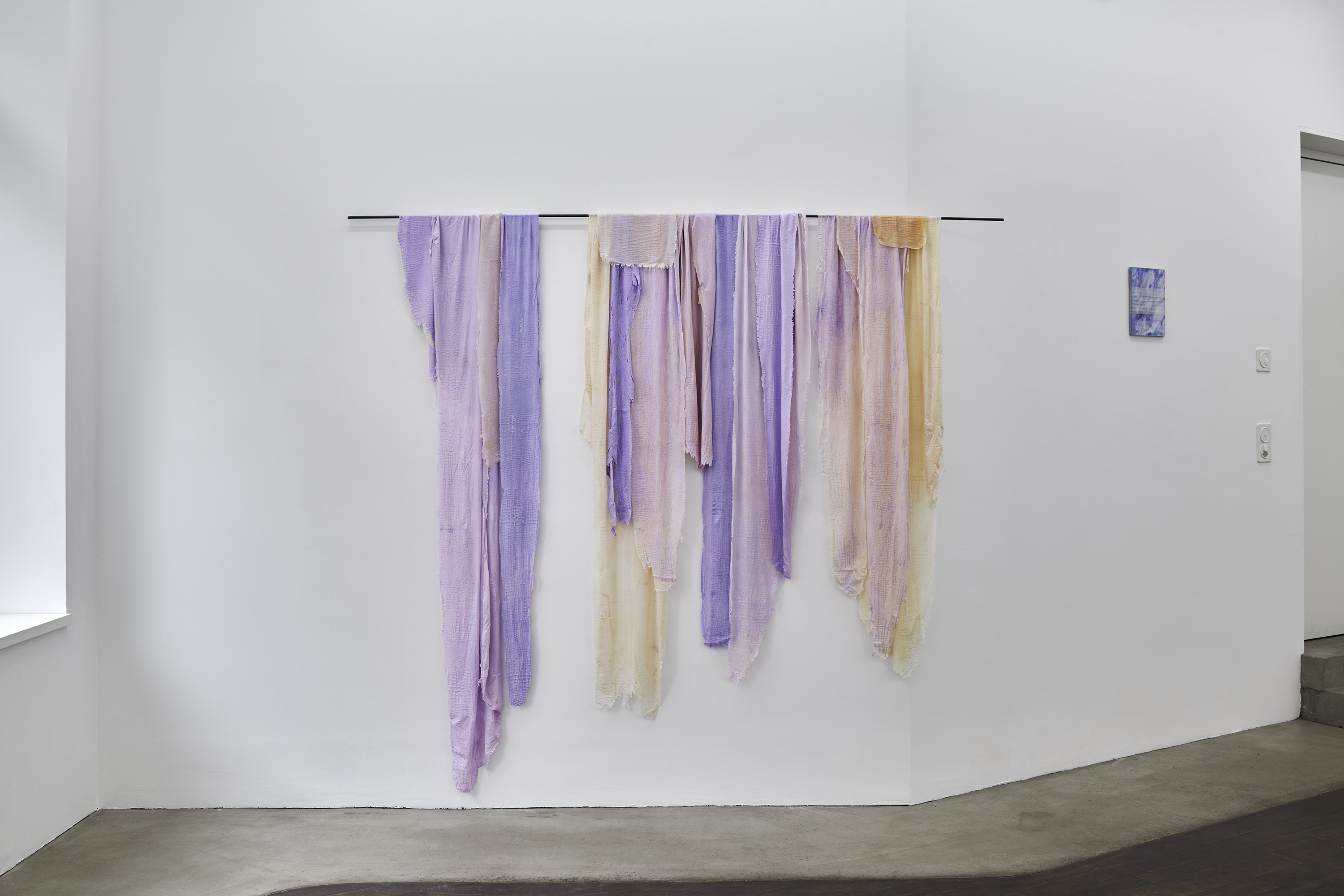
A large composite painting anchors the space: at first a heavy, geological mass (isthe serpent under there?) until its surface fractures, letting colors slowly emerge, while dissolving the impression of solidity. Nearby, a puddle of cold, sharp aluminum interrupts that reading. Flat and reflective, it gathers light in a way that feels both inviting and suspicious, unsettling our sense of shadow, reflection, and what counts as solid. Though our minds read it as water, it remains a surfaceperforming depth without offering it. Close by, ceramic egg fragments sit in suspension, their faint, feral scent lingering in the air and occupying all cracks. On the walls, latex skins hang like shed surfaces, their pastel tones shifting them toward something coded, almost decorative, yet faintly unsettling. The shedding has happened. And within this constellation, a circular form quietly echoes the ouroboros, a looped gesture folding desire, continuity and return into a single, charged motif.
Around these works, boundaries are meant to blur. Materials associated with the synthetic take on organic qualities, while the organic appears staged or mediated. Under Massimiliano Rossetto’s guidance, the serpent gains a conceptual layer aligned with queer ecology, where nature resists fixed categories and stable identities. In this framework, the serpent is freed from its initial interpretationand inhabits its own indeterminacy, as a liminal and mutable being.
Around these works, boundaries are meant to blur. Materials associated with the synthetic take on organic qualities, while the organic appears staged or mediated. Under Massimiliano Rossetto’s guidance, the serpent gains a conceptual layer aligned with queer ecology, where nature resists fixed categories and stable identities. In this framework, the serpent is freed from its initial interpretationand inhabits its own indeterminacy, as a liminal and mutable being.
At this point, you might wonder whether the serpent ever existed. The exhibition offers no answer. Instead, it keeps the viewer within a field of open perceptions. As the serpent slips into this uncertain space, it becomes easier to see it as part of a wider lineage of liminal beings tied to lakes, forestsand mountains, figures of otherness rooted in specific lands. Rather than treating them as modern monsters, the work invites another approach. In the original legend, the serpent is not defeated through force: a villager’s protective song unsettles the environment and sets in motion the events that lead to its end without a single blow. What becomes apparent is that the shift concerns not onlythe serpent’s disappearance, but the changing terms through which humans relate to the unknown.In that sense, the serpent of the Verzasca aligns with dragons, water spirits and other hybridpresences that mark thresholds where the world behaves differently, reminding us that landscapes are full of edges where certainty loosens and change begins.